Geologists Team at HKU Becomes First in Hong Kong to Retrieve Lunar Samples - Set to Unveil the Mysteries of the Moon's Volcanic History
Administrator Selasa, 08 Agustus 2023 07:54 WIB
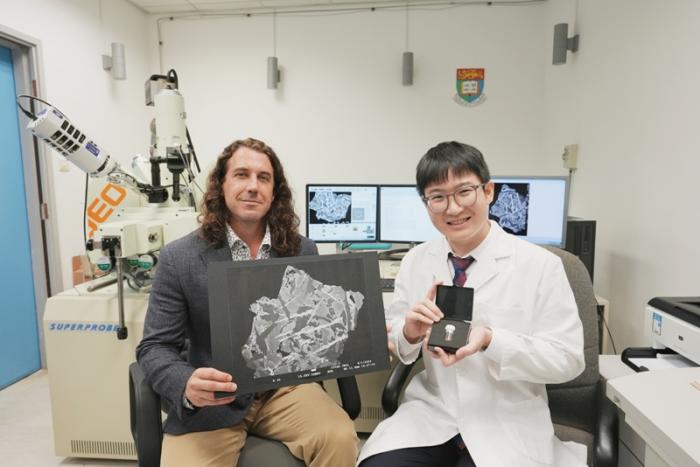
HONG KONG SAR - 7 August 2023 - The geologists at The University of Hong Kong (HKU) have achieved a historic feat by obtaining lunar soil samples collected by the Chinese lunar probe Chang'e-5 in 2020. This marks the first time that a Hong Kong research team has secured such samples.
With the support of Dr Joseph MICHALSKI of HKU Department of Earth Sciences, Postdoctoral Fellow Dr Yuqi QIAN formed a team to apply for the lunar samples. The team obtained approval from the China National Space Administration's Lunar Exploration and Space Engineering Centre to study the lunar soil samples.
Led by postdoctoral fellow Dr Yuqi QIAN from the Department of Earth Sciences, Faculty of Science, the team obtained approval from the China National Space Administration's Lunar Exploration and Space Engineering Centre to study the lunar soil samples. Dr Qian personally travelled to Beijing to retrieve the samples, which weigh 822.6 milligrams in total. These lunar samples offer valuable insights into the Moon's geological and thermal history and its connection to the formation and evolution of planetary bodies in the Solar System. The achievement by the HKU team underscores the university's growing contributions to China's lunar and planetary exploration efforts.
'This is a dream come true for us and Hong Kong's space science community,' said Qian, who is eager to analyse the samples using state-of-the-art instruments at the university. 'We hope to reveal the secrets of the Moon and gain insights into the early Earth, which could have important implications for our understanding of the Solar System and beyond.'
Previous Study on the Chang'e-5 Landing Site Paves the Way
Dr Qian is making waves in the field of planetary geology with his exceptional research on the Chang'e-5 landing site. Having published the first paper documenting the site and constructing a complete picture, he has been focusing on different aspects such as regolith properties, volcanic history and the provenance of lunar soils. His research work has been published in top-tier journals and widely cited, with over 400 citations, solidifying his position as an emerging expert. Recently, Dr Qian joined HKU as a postdoctoral fellow after obtaining his doctoral degree in Planetary Geology from China University of Geosciences.
Drawing on years of research on the Moon, the most exhilarating moment of his research career was an exciting discovery regarding the latest volcanic activity on the Moon's surface – he discovered that the eastern part of the pre-selected Chang'e-5 landing region contained one of the youngest mare basalts on the Moon.
Recognising the scientific significance of this finding, he proposed that Chang'e-5 should explore this region to collect these young basalts, which were younger than any previously returned lunar basalts.
In 2020, Chang'e-5 successfully landed on the lunar surface within the Procellarum KREEP Terrane, a chemical anomaly province known for its elevated heat-producing elements and lunar volcanic deposits. Upon analysing the samples collected from this region, scientists were stunned to discover that the basalts were 2.0 billion years old - almost 1 billion years younger than any previous lunar volcanic samples collected by Apollo or Luna missions. This ground-breaking discovery confirmed Dr Qian's prediction and has reshaped our understanding of lunar history. It has also raised the question: how did the young volcanism originate?
Dr Qian had been working tirelessly on this question, using remote sensing techniques to explore the volcanic history of the Chang'e-5 landing site. His previous research proposed that the Chang'e-5 basalts originated from the source vent of Rima Sharp, whose channel is only ~15 km from the landing site. Rima Sharp is a lunar sinuous rille whose formation required tons of lavas and was highly likely to be sampled by Chang'e-5.
Gearing up for Insights into Moon's Volcanic History and Evolution of Planetary Bodies in the Solar System
After joining HKU, Dr Qian recognised the potential of the support and resources available at the university to make progress in understanding young lunar volcanism with samples. When Dr Qian learned about the sixth batch of lunar research samples is open for application earlier this year, he swiftly mobilised scientists in the department to join his application. 'I knew this was an opportunity we could not miss for the further development of lunar science at HKU and with our collaborators throughout Hong Kong,' said Dr Qian.
With the support of Dr Joseph MICHALSKI of the Department of Earth Sciences, an expert with extensive experience in planetary geology and mineralogy, Dr Qian formed a team to apply for the lunar samples. Other members of the department included Professor Guochun ZHAO, a renowned geologist specialising in tectonic processes and the evolution of the Earth's lithosphere; Dr Weiran LI, a volcanologist specialising in magmatism, volatile cycling, and volcanic hazards; Professor Min SUN, a prominent geochemist focusing in the evolution of old continents; Professor Jian ZHANG, a structural geologist with expertise in crustal growth and tectonic evolution; and Dr Yiliang LI, an astrobiologist whose research centres in the search for life beyond Earth.
More information about Dr Yuqi Qian: https://yuqiqian.com
More information about Dr Joseph Michalski: https://www.clays.space
Learn about Dr Qian's EPMA Analysis of Lunar Samples in this Video: http://bit.ly/HKULunarSamples2023
Image download: https://bit.ly/LunarSamples2023PC
Hashtag: #HKU